

The Limits of Optimization


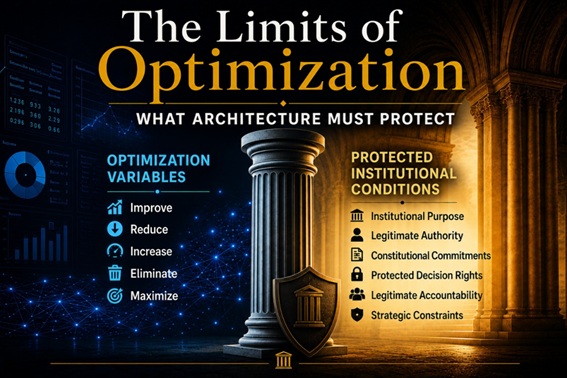 What Architecture Must Protect Optimization has become one of the defining ambitions of contemporary organizations. Improve performance. Reduce cost. Increase speed. Eliminate waste. Maximize efficiency. Artificial intelligence has amplified these ambitions dramatically. Organizations can now analyse vast amounts of information, identify patterns that previously remained invisible, simulate alternatives and continuously improve operational decisions at unprecedented scale and speed. These capabilities create extraordinary opportunities. Organizations that continuously improve how they allocate resources, coordinate activities and support decisions become more responsive, more resilient and better prepared to compete. Optimization is therefore not the problem. It is an essential organizational capability. The problem begins when organizations assume that everything capable of being optimized should become an object of optimization. That assumption appears reasonable. If something can be improved, why should it not be? Because optimization always depends upon conditions that it cannot independently legitimize. Every optimization process requires an objective. Every objective embodies criteria of value. Those criteria reflect priorities. Those priorities express institutional choices. Optimization does not produce those choices. It operates within them. This distinction is fundamental. Optimization is an instrumental capability that improves organizational performance within legitimately established architectural conditions. It may inform their review, but it cannot independently determine or redefine the Protected Institutional Conditions that make optimization itself legitimate. As organizations become increasingly AI-enabled, this distinction becomes considerably more important. Computational capabilities are becoming remarkably effective at recommending actions, allocating resources, sequencing work, coordinating activities and continuously improving operational performance. As these capabilities expand, so does the temptation to allow optimization itself to shape organizational priorities. That temptation is understandable. If optimization consistently improves operational outcomes, why should it not also determine what deserves to be optimized? Because organizational purpose cannot be derived from optimization. Neither can legitimate authority. Nor constitutional commitments. Nor legitimate accountability relationships. Optimization can identify increasingly effective ways of pursuing organizational objectives. It cannot independently determine which objectives remain institutionally legitimate. It can recommend more effective distributions of resources, responsibilities and decision flows. It cannot independently redefine the Protected Institutional Conditions that authorize those distributions. Optimization therefore operates within a framework of legitimacy that necessarily precedes every optimization process. That framework is expressed through Protected Institutional Conditions. This relationship fundamentally changes how optimization should be understood. Optimization is not an alternative to governance. It is one of the capabilities that governance enables. Governance, through architecture, establishes the Protected Institutional Conditions within which optimization can continuously improve organizational performance while remaining legitimate. When those Protected Institutional Conditions remain legitimate and sufficiently stable, optimization can create value. This distinction reveals that organizations operate with two fundamentally different categories. The first consists of Optimization Variables. These are elements whose continuous improvement is precisely the purpose of optimization. Operational processes. Resource allocation. Scheduling. Information flows. Operational quality. The second consists of Protected Institutional Conditions. Protected Institutional Conditions are legitimately established architectural conditions that provide continuity, direction and legitimacy to optimization and cannot be reduced to ordinary optimization variables within the systems whose operation they govern. Institutional purpose. Legitimate authority. Constitutional commitments. Protected decision rights. Legitimate accountability relationships. Strategic constraints. These conditions are not immutable. They may be reviewed. They may evolve. They may even be fundamentally redesigned. Their evolution, however, requires legitimate governance. It cannot emerge autonomously from the optimization processes they themselves authorize. Organizations often evaluate optimization through improvements in efficiency, productivity, quality or speed. These measures matter. But they describe only operational performance. They say very little about whether optimization has preserved the Protected Institutional Conditions required for the organization to remain governable. An organization may become operationally stronger while simultaneously becoming institutionally weaker. That possibility becomes increasingly significant as optimization extends beyond operational execution into decision formation itself. Artificial intelligence increasingly influences which information receives attention, which alternatives appear most attractive, how risks are prioritized and which recommendations become more persuasive. Each individual optimization may appear entirely reasonable. Collectively, however, those same optimizations may gradually reshape Protected Institutional Conditions that cannot legitimately become ordinary optimization variables. Authority may become progressively subordinate to efficiency. Purpose may become progressively subordinate to measurable outcomes. Legitimate accountability relationships may become progressively subordinate to predictive confidence. Institutional commitments may become progressively subordinate to local optimization. None of these shifts normally results from a single decision. They emerge gradually through many individually rational improvements. That is precisely why Architectural Governance becomes increasingly important. It preserves the distinction between Optimization Variables and Protected Institutional Conditions. Without that distinction, organizations do not simply optimize more. They gradually lose the Protected Institutional Conditions through which optimization itself remains legitimate. Architectural Governance does not exist to limit optimization. It exists to preserve the Protected Institutional Conditions that allow optimization to remain legitimate as organizations continuously evolve. This distinction fundamentally separates optimization from governance. Optimization asks: How can this objective be achieved more effectively? Governance asks: Should this objective continue to guide organizational action? These questions are complementary. But they are not interchangeable. Optimization improves performance. Governance determines legitimate institutional direction. Organizational architecture translates that direction into the conditions through which organizational action can remain coherent. Architectural Governance preserves those Protected Institutional Conditions while governing their legitimate evolution. Each performs a distinct organizational function. Confusing them gradually weakens all of them. This hierarchy becomes increasingly important as computational capabilities become more autonomous. Artificial intelligence can optimize decisions at a speed, scale and consistency that human organizations have never previously achieved. That capability represents an extraordinary organizational opportunity. But every increase in optimization capability also increases the importance of preserving the Protected Institutional Conditions that optimization itself cannot independently redefine. Otherwise, optimization gradually shifts from improving organizational performance to reshaping the institutional foundations that define organizational purpose. That transition rarely occurs through deliberate intent. It emerges incrementally. One optimization improves efficiency. Another removes friction. Another simplifies coordination. Another reallocates authority. Each decision appears locally rational. Collectively, however, they may gradually transform Protected Institutional Conditions that should evolve only through legitimate governance. This is why the limits of optimization are not technological. They are institutional. The greatest risk is not that optimization becomes more capable. It is that organizations gradually lose the distinction between improving performance and preserving the Protected Institutional Conditions that make performance meaningful. Optimization may recommend that Protected Institutional Conditions should be reviewed. It may reveal tensions. Identify inconsistencies. Simulate consequences. Support alternative designs. It can become an indispensable contributor to institutional learning. But it cannot independently authorize the redesign of the Protected Institutional Conditions that govern its own operation. Those decisions remain matters of legitimate governance. Protected Institutional Conditions are therefore not exceptions to adaptation. They are the institutional framework through which adaptation remains coherent, legitimate and strategically consequential. They provide continuity without creating rigidity. They enable evolution without allowing every institutional commitment to become an ordinary optimization variable. This is why optimization should never be understood as an autonomous organizational logic. Its value depends upon remaining embedded within legitimately governed Protected Institutional Conditions. The more powerful optimization becomes, the more valuable Architectural Governance becomes. Not because governance exists to constrain optimization. But because it preserves the Protected Institutional Conditions that allow optimization to continue serving the organization rather than gradually redefining it. Organizations therefore do not become stronger by optimizing everything. They become stronger by distinguishing between what should continuously improve and what must continue providing legitimate direction to that improvement. The future of AI-enabled organizations will depend not only on how intelligently they optimize. It will depend equally on how deliberately they preserve the Protected Institutional Conditions that optimization itself cannot legitimately replace. Optimization remains indispensable. Governance remains indispensable. Architectural Governance preserves the relationship between them. That relationship may ultimately become one of the defining capabilities of successful AI-enabled organizations. Yet one final question remains. If organizations must preserve the Protected Institutional Conditions that make governance legitimate, who preserves the legitimacy of governance itself? That is where the final article begins. Beyond Governance Who Governs the Governors? |
Posted on: August 21, 2026 06:28 AM
| Permalink |
Comments (0)
M.O.R.E. Expands What Project Professionals Are Expected to Own. But Does Their Authority Expand with Their Accountability?
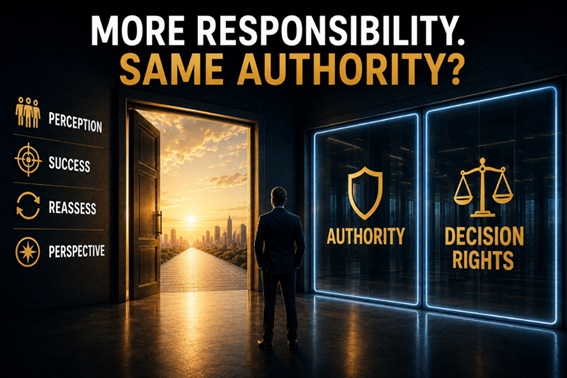 I recently completed PMI's M.O.R.E. Masterclass. Its central proposition deserves serious consideration. Project professionals should not define success narrowly through execution. They should Manage Perceptions, Own Success, Relentlessly Reassess and Expand Perspective. PMI's current research reframes project success beyond schedule, budget and scope toward a broader conception incorporating stakeholder value and desired outcomes. There is much to support in that direction. A project can deliver what was planned and still fail to create meaningful value. Assumptions can become invalid. Stakeholder expectations can change. Benefits may depend on adoption long after delivery. Organizational conditions can evolve while the project is underway. Project professionals should care about all of this. But taking M.O.R.E. seriously raises a question that deserves equal attention: If M.O.R.E. expands what project professionals are expected to own, does their authority expand with their accountability? The answer is more complex than it first appears. The Move Beyond Execution Did Not Begin with M.O.R.E. Historical continuity matters when evaluating claims of professional change. In 2013, Jack S. Duggal presented How to change the world?: The next generation of project managers at PMI Global Congress 2013, North America. It was not a PMI standard and should not be represented as an official institutional position. But it formed part of PMI's professional intellectual ecosystem. Read today, its argument is striking. Duggal directly addressed the "Ownership and Accountability of Benefits and Outcomes" and challenged the conventional separation between responsibility for project execution and responsibility for benefits and outcomes. His broader argument moved toward holistic and integrative project management, stakeholder adoption and experience, adaptation, and greater responsibility for overall project success. This is not merely evidence that isolated components of M.O.R.E. existed before M.O.R.E. It is evidence of something more significant. More than a decade earlier, an integrated professional proposition combining broader project success, outcome ownership, stakeholder experience, holistic thinking, adaptation and responsibility beyond delivery had already been articulated within PMI's professional intellectual ecosystem. And this was not an isolated formulation. In 2014, Duggal extended the argument in How to change the world with project management. He again questioned narrow responsibility for execution and delivery, explicitly addressed ownership and accountability for benefits and outcomes, and connected project management more closely with change, adoption, results and benefits realization. Taken together, the two papers establish a documented intellectual continuity: Execution and delivery → adoption and outcomes Deliverables → benefits and value Narrow project responsibility → broader ownership Control → sensing, adjustment and adaptation Project manager → more integrative change-oriented professional That does not establish that M.O.R.E. derives from Duggal's work. Temporal precedence is not intellectual derivation. But it changes the novelty question. If a substantially integrated proposition combining broader success, outcome ownership, stakeholder experience, holistic thinking and continuous adaptation was already articulated within PMI's intellectual ecosystem in 2013 and further developed in 2014, what is substantively new in M.O.R.E. beyond its empirical codification, behavioral translation and institutional amplification? That is a more demanding test than asking whether individual M.O.R.E. practices existed before. It asks whether the integration itself is new. The Historical Record Is Richer Than Execution Versus Value The issue extends beyond these two conference papers. PMI's Benefits Realization Management work subsequently emphasized strategic alignment, value creation, benefits ownership, defined roles and explicit accountability. PMI states that BRM requires effective cooperation, defined roles and responsibilities, ownership and accountability, and identifies the benefits owner as an important role in overseeing benefits realization. This matters because it challenges an overly simple historical narrative: Traditional project management → scope, schedule, cost and execution versus Contemporary project management → value, outcomes, stakeholders, adaptation and impact. PMI's own intellectual history is more sophisticated than that contrast suggests. Long before M.O.R.E., its ecosystem was already wrestling with value, benefits, strategic alignment, stakeholder experience, broader definitions of project success, adaptation and accountability for outcomes. M.O.R.E. therefore cannot reasonably be treated as the origin of project management's movement toward value. The more interesting question is what it does with that inheritance. The Other Side of the Historical Debate Expanding responsibility for outcomes has always created another problem. Projects do not produce value through the project professional alone. Benefits may depend on business owners. Adoption may depend on operations. Product value may depend on product decision-making. Strategic priorities and investment decisions may belong to executives or governance bodies. Resources may be controlled outside the project. PMI's own BRM work recognized precisely this distributed reality by emphasizing defined roles, cooperation, benefits ownership and accountability. This reveals a fundamental organizational distinction: Value may be collectively produced, but authority, decision rights and accountability remain distributed. A project professional may recognize that a business case is deteriorating while someone else retains authority to continue the investment. They may identify that expected benefits are at risk while operational functions control the conditions necessary to realize them. They may challenge a strategic assumption while executives retain authority over strategy. They may recommend stopping a project without possessing legitimate authority to terminate it. The professional can and should exercise agency in all these situations. But agency is not authority. Influence is not a decision right. And concern for an outcome is not necessarily accountability for producing it. This Makes "Own Success" Particularly Important PMI's 2024 Maximizing Project Success research makes one of its four implications explicit: Own project success: Be accountable for the project's value, not only its execution. The four implications were: Manage perceptions. Own project success. Reassess parameters. Expand perspective. They subsequently became recognizable as the architecture of M.O.R.E.: Manage Perceptions. Own Success. Relentlessly Reassess. Expand Perspective. The 2025 Step Up research reports that 69% of stakeholders and executives expect project professionals to take primary responsibility for the elements embodied by M.O.R.E. It also reports an increase in NPSS from 27 to 94 when project professionals consistently practice all four elements. PMI now explicitly calls on project professionals to take greater ownership and move beyond execution toward outcomes and value. That makes the meaning of ownership more than a semantic issue. It becomes a governance question. What Does It Mean to Own Success? At least three interpretations are possible. 1. Behavioral Ownership "Own Success" may mean that project professionals refuse to hide behind the formal boundaries of delivery. They seek evidence. Question assumptions. Understand value. Challenge decisions. Influence stakeholders. Recommend action. Escalate threats they cannot legitimately resolve themselves. This interpretation is highly defensible. It expands professional agency without necessarily redistributing formal accountability. But it creates a novelty problem. If this is what Own Success means, much of its intellectual substance has strong antecedents in established project-management knowledge, including the integrated professional propositions articulated by Duggal in 2013 and 2014. 2. Shared Accountability Perhaps success is jointly owned across project professionals, sponsors, business owners, benefits owners, product leaders, executives and operational functions. That too can be defensible. But shared accountability requires architecture. Who decides? Who recommends? Who approves? Who commits resources? Who can change success criteria? Who owns benefits after transition? Who can terminate the investment? Who remains answerable when stakeholders disagree about what constitutes value? Without differentiation, shared accountability can become diluted accountability. 3. Substantive Outcome Accountability The strongest interpretation would make the project professional meaningfully accountable for overall project success and value. That would represent a more consequential professional shift. But it immediately creates another question: Where is the corresponding expansion of authority and decision rights? Accountability cannot simply migrate while the organizational power required to influence the relevant outcomes remains elsewhere. The M.O.R.E. Ownership Trilemma This produces what I would call the M.O.R.E. Ownership Trilemma: If "Own Success" denotes substantive outcome accountability, it requires a corresponding architecture of authority and decision rights. If it denotes shared accountability, it requires explicit differentiation to prevent accountability dilution and role conflict. If it denotes proactive professional agency within existing governance boundaries, it remains governance-coherent, but its incremental contribution over established project-management knowledge becomes more modest. None of these interpretations makes M.O.R.E. irrelevant. But they represent materially different propositions. And distinguishing between them determines what M.O.R.E. is actually asking the profession to become. The Strongest Defense of M.O.R.E. A serious critique should confront the strongest defense available. Perhaps M.O.R.E. is simply not intended to be a governance architecture. The 2026 From Vision to Practice: A Playbook to Apply M.O.R.E. provides practitioner-oriented guidance for applying M.O.R.E. and presents the framework as a practical way of moving beyond task execution toward owning outcomes and delivering value. This supports a plausible interpretation: M.O.R.E. may be better understood as a behavioral layer operating within a richer project-management architecture, rather than as a replacement for that architecture. That is a legitimate design choice. A behavioral framework does not need to reproduce every distinction contained in governance, sponsorship, benefits management, product management, systems thinking or the PMBOK Guide. Indeed, simplification may be one of its strengths. Four memorable dimensions can translate a large and fragmented body of professional knowledge into behaviors that practitioners can more easily remember, discuss and apply. But accepting this defense does not end the analysis. It creates another test: Can a simplified behavioral layer be safely and correctly applied when its meaning depends on governance distinctions that the layer itself does not fully express? For an experienced practitioner, "Own Success" may naturally mean: Understand, challenge, influence, recommend and escalate, while respecting legitimate decision authority. A less experienced practitioner may interpret exactly the same language as: I am responsible for making this project successful. Those are not equivalent propositions. Cognitive compression creates accessibility. It can also remove distinctions. Responsibility, Agency and Accountability Are Not the Same Three concepts should therefore remain distinct. Epistemic responsibility is the duty to understand what is happening, seek evidence, question assumptions and recognize material consequences. Professional agency is the duty to act on that understanding through challenge, recommendation, influence, collaboration and escalation. Outcome accountability is answerability for results within an architecture of legitimate authority, decision rights and meaningful causal influence. A project professional can possess extensive epistemic responsibility and professional agency without controlling every condition necessary to produce the eventual outcome. That is not diminished leadership. It is coherent governance. Was the Research Designed to Confirm PMI's Strategy? There is another question that deserves scrutiny. PMI's strategic commitment to maximizing project success preceded the publication of the 2024 research, and the research subsequently generated the broader project-success definition and four behavioral implications that would develop into M.O.R.E. PMI itself described the 2024 initiative as part of its commitment to Maximizing Project Success. That chronology raises a legitimate question: Was the research architecture sufficiently independent to discover something materially inconsistent with the institutional strategy within which it was conceived? The strongest criticism would be that the research was simply designed to validate a predetermined institutional conclusion. The evidence examined does not justify that claim. That conclusion matters. The 2024 program involved approximately 10,000 project professionals and 150 in-depth interviews. PMI describes the research goal as developing a definition of project success, measuring project success rates globally and understanding which factors are predictive of success. The underlying research considered different formulations of project success and both execution-oriented and outcome-oriented dimensions. There was therefore genuine empirical room for findings less aligned with a simplistic outcomes-only narrative. The strongest allegation of a wholly predetermined study does not survive the evidence currently available. But a more sophisticated question does. Data-Level Independence Is Not Interpretive-Level Independence Empirical evidence can tell us that stakeholders value outcomes. It can show associations between particular behaviors and perceived project success. It can identify factors predictive of success. But none of those findings automatically establishes: Project professionals should be accountable for the project's value. That is also a normative proposition about professional responsibility and governance. There is an inferential bridge between: What constitutes or predicts project success and Who should be accountable for producing that success. That bridge deserves explicit justification. The same issue arises in the subsequent M.O.R.E. research. PMI reports a striking relationship between consistent application of the four M.O.R.E. elements and NPSS, rising from 27 to 94. The 2026 Playbook states that professionals who fully adopt M.O.R.E. see their NPSS more than triple. Elsewhere, PMI uses even stronger public-facing language. Its M.O.R.E. page says that when project professionals fully embrace the four practices, "project success nearly quadruples", while its December 2025 press release says that M.O.R.E. "more than triples success rates." This makes methodological precision essential. Association, prediction and causation are not interchangeable. Higher-performing organizational environments may simultaneously enable M.O.R.E.-consistent behavior and produce greater project success. Governance maturity may matter. Leadership quality may matter. Professional competence may matter. Project selection may matter. Organizational capability may matter. Other variables may influence both behavior and outcomes. The stronger the causal language becomes, the stronger the evidence required to sustain it. The Research Question Therefore Changes The relevant question is no longer: Was M.O.R.E. simply invented to prove PMI's strategy? The evidence currently available does not support that conclusion. A better question is: How independent was the interpretation and normative codification of the empirical findings from the institutional strategy within which the research was conceived? That is a much more demanding methodological question. It distinguishes data-level independence from interpretive-level independence. And it avoids both extremes. We should neither assume institutional manipulation without evidence nor assume that a large empirical study makes the transition from evidence to institutional prescription epistemically neutral. What, Then, Is Actually New in M.O.R.E.? This brings the novelty question back into focus. The core intellectual territory occupied by M.O.R.E. has substantial antecedents in earlier project-management knowledge. More importantly, Duggal 2013 and 2014 weaken even the stronger proposition that M.O.R.E.'s principal conceptual novelty lies simply in integrating those elements. An integrated professional vision had already been articulated around: Broader project success, Outcome ownership, Stakeholder experience and adoption, Holistic thinking, Adaptation, Benefits and value, Responsibility beyond delivery. M.O.R.E.'s contribution may therefore lie elsewhere. It may provide cognitive compression, organizing dispersed expectations into four memorable dimensions. It may provide behavioral translation, converting broad principles into practitioner-level practices. It may provide pedagogical integration, enabling these behaviors to be taught through cases, reflection and application. It may provide a common professional language capable of crossing predictive, adaptive and hybrid environments. It adds empirical codification, associating a defined behavioral architecture with PMI's contemporary measure of project success. And perhaps most importantly, it provides institutional amplification, making this conception of professional behavior central to PMI's contemporary vision of the profession. PMI describes M.O.R.E. as a call to action for the profession and directly connects it with the shift from project management success to project success. These are potentially meaningful contributions. But they are different from originating the underlying project-management knowledge. A framework can add substantial practical value without inventing its constituent ideas. The appropriate test is therefore not simply: Is M.O.R.E. new? It is: Does the particular M.O.R.E. architecture create explanatory power, predictive value, practical utility or professional capability beyond what existed in its constituent and integrated antecedents? That remains an empirical question. The Harder Question Is Organizational The central issue is therefore not whether project professionals should care about outcomes. They should. Nor should the profession retreat into narrow execution. The historical evidence makes clear that this debate was already moving beyond such boundaries many years ago. The harder question is: How far can professional responsibility expand before organizational authority must expand with it? Suppose a project professional discovers that the business case no longer holds. There is a duty to notice. A duty to investigate. A duty to evidence. A duty to challenge. A duty to recommend. And, where necessary, a duty to escalate. But authority to terminate the investment is a separate matter. The same distinction applies to strategic choices, product decisions, benefits realization, operational adoption and resource allocation. Expanded professional responsibility does not automatically confer expanded decision legitimacy. Toward Governable Professional Agency This suggests a principle that could complement M.O.R.E.: A project professional's accountability for outcomes should remain proportionate to the legitimate authority, decision rights, competence, causal influence and opportunity to act available to that professional. This principle does not reduce professional responsibility. It expands responsibility while preserving legitimate attribution. Project professionals should see more. Understand more. Question more. Reassess more. Challenge more. Influence more. Escalate when necessary. And care deeply about whether projects actually create value. But organizations must preserve clarity about who possesses authority to decide and who remains accountable for outcomes dependent on those decisions. Otherwise, expanded professional ownership risks transforming an organizational governance problem into an individual responsibility problem. Perhaps the Real Opportunity Is to Connect the Two M.O.R.E. asks an important question: What more should project professionals do to help projects succeed? Organizations need to answer its counterpart: What must governance, authority and decision rights enable so that project professionals can legitimately exercise that expanded agency? The two questions belong together. The future of project management should not be a return to execution. But neither should it become an expansion of accountability without boundaries. The objective should be governable professional agency. Expand professional agency as far as necessary to understand, challenge, influence and protect project value. Keep formal outcome accountability traceable to the legitimate authority, decision rights and causal influence through which that value can actually be produced. M.O.R.E. may therefore be most valuable not because project management has finally discovered value, nor because project professionals should simply become accountable for everything that determines success. Its stronger contribution may be its ability to make long-developing professional expectations more visible, memorable, actionable and institutionally salient. If so, the next step is not simply to ask project professionals to own more. It is to ensure that what they are expected to own, what they are empowered to decide, and what they can legitimately be held accountable for remain coherent. That is where M.O.R.E. meets governance. And that is where the more important conversation begins. References Duggal, J. S. (2013). How to change the world?: The next generation of project managers. Paper presented at PMI® Global Congress 2013, North America, New Orleans, LA. Project Management Institute. PMI official source, Duggal 2013 Duggal, J. S. (2014). How to change the world with project management. Paper presented at PMI® Global Congress 2014, EMEA, Dubai, United Arab Emirates. Project Management Institute. PMI official source, Duggal 2014 Project Management Institute. (2016). Establishing Benefits Ownership and Accountability. Benefits Realization Thought Leadership Series. PMI official source, Benefits Ownership and Accountability The Boston Consulting Group. (2016). Connecting Business Strategy and Project Management. Benefits Realization Thought Leadership Series, Project Management Institute. PMI official source, Connecting Business Strategy and Project Management Project Management Institute. (2024). Maximizing Project Success: What Is Project Success? PMI official source, Maximizing Project Success Project Management Institute. (2024). Project Management Institute Champions a New Era of "Project Success": Launches Groundbreaking Research to Drive Value and Recognition for the Profession. PMI official source, 2024 research announcement Project Management Institute. (2025). Step Up: Redefining the Path to Project Success with M.O.R.E. PMI official source, Step Up Walker, D. (2025). Step Up: A New Vision for Project Success. Project Management Institute. PMI official source, Step Up: A New Vision for Project Success Project Management Institute. (2025). New PMI Research Reveals Strategy-Execution Gap Is Undermining Transformation – And How to Close It. PMI official press release Project Management Institute. (2026). From Vision to Practice: A Playbook to Apply M.O.R.E. PMI official source, M.O.R.E. Playbook Project Management Institute. (2026). Delivering M.O.R.E. PMI official source, Delivering M.O.R.E. |
Posted on: August 20, 2026 12:50 PM
| Permalink |
Comments (2)
Constraint as a Strategic Capability
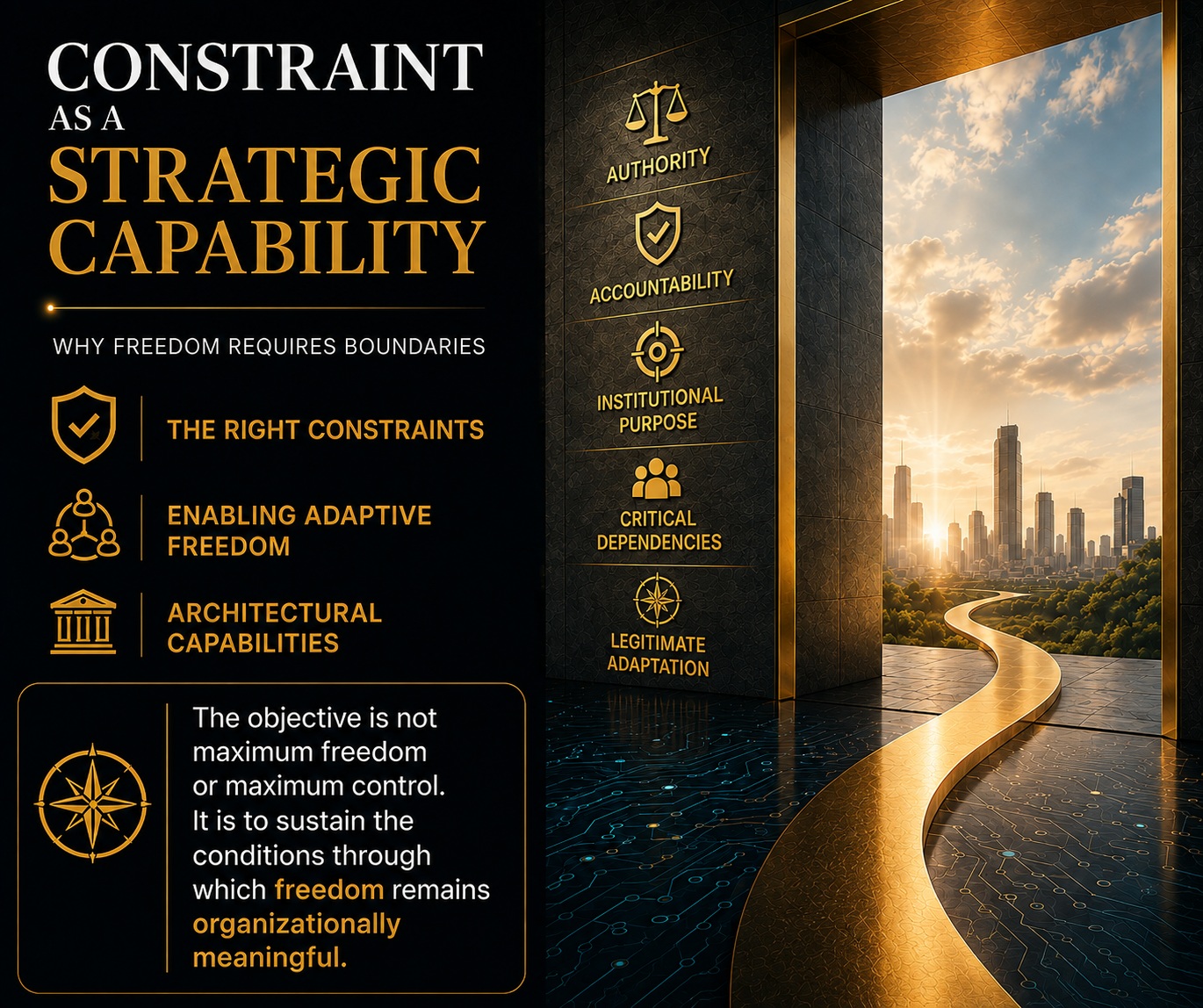 Why Freedom Requires Boundaries For decades, organizations have pursued a remarkably consistent objective. Greater flexibility. Greater autonomy. Greater empowerment. The underlying assumption has been equally straightforward. The fewer the constraints, the greater the organization's ability to adapt. This intuition is partly correct. Organizations burdened by unnecessary bureaucracy become slower, less innovative and less responsive. Removing obsolete constraints can therefore create genuine value. But removing constraints does not automatically create adaptability. Organizations become adaptive not because constraints disappear, but because the right constraints remain. Every organization depends upon boundaries. Authority must be distributed. Responsibilities must be assigned. Decision rights must be defined. Some actions may be delegated. Others require authorization. Certain commitments must remain protected from ordinary operational discretion. Without these conditions, freedom does not become autonomy. It becomes ambiguity. Coordination weakens. Responsibility becomes difficult to attribute. Local decisions gradually diverge from collective purpose. The strategic question is therefore not whether constraints should exist, but whether they preserve or undermine the organizational capabilities required for coherent adaptation. That question becomes increasingly important as organizations become more deeply AI-enabled. Organizational action no longer develops exclusively through individual human decisions. It increasingly emerges through continuous interactions between people, teams and computational capabilities. Under these conditions, organizations cannot rely on continuous executive supervision to maintain direction. Nor can they approve every operational decision without weakening the adaptability they seek to create. Legitimately authorized institutional intent must therefore be translated into the organizational architecture within which action occurs. That is where constraints acquire strategic significance. Within many organizations, constraints are still understood primarily as mechanisms of control. They define what people cannot do. Their value is measured largely by the behaviour they prevent. That understanding is becoming increasingly incomplete. A poorly designed constraint limits capability. A well-designed constraint preserves it. The difference lies not in whether a boundary exists, but in what that boundary protects. A constraint designed merely to reduce discretion can become an obstacle to judgment and adaptation. A constraint designed to protect legitimate authority, institutional purpose, accountability and critical dependencies can increase organizational autonomy because it reduces uncertainty without prescribing every decision. The objective is therefore neither maximum freedom nor maximum control. It is to sustain the conditions through which freedom remains organizationally meaningful. Seen from this perspective, constraints are no longer merely mechanisms of compliance. They can become architectural capabilities. A strategic constraint is an architectural capability because it preserves the organizational conditions through which autonomy, adaptation and judgment remain coherent, legitimate and strategically consequential across continuous organizational evolution. This definition changes how strategic constraints should be evaluated. Their value does not depend primarily on the behaviour they restrict. It depends on the organizational capability they sustain. A strategic constraint does not prescribe every choice. It establishes the conditions within which many different choices can remain legitimate. Rather than concentrating intelligence, it allows intelligence to become distributed without fragmenting purpose. Teams can adapt to local realities. Managers can exercise delegated authority. Computational capabilities can recommend, coordinate and execute actions within legitimate architectural boundaries. Governance does not need to intervene in every action because legitimately authorized institutional intent has already been translated into the conditions through which organizational action emerges. This explains why better boundaries often create greater autonomy. When authority is clear, fewer decisions require escalation. When critical outcomes are explicit, teams can experiment with greater confidence. When unacceptable states are architecturally defined, computational capabilities can operate with greater independence. When the conditions for intervention are protected, human judgment can be concentrated where interpretation, conflicting values and institutional responsibility create the greatest organizational value. Strategic constraints therefore do not diminish judgment. They protect the organizational space in which judgment remains necessary and consequential. This reveals a form of capability that is often overlooked. Capabilities are usually understood as resources, technologies, skills or processes that enable organizations to perform activities. Strategic constraints represent something fundamentally different. This is not primarily a capability to perform more activity. It is a capability to maintain organizational integrity while activity evolves. That capability becomes increasingly valuable as complexity grows. Different teams pursue different objectives. Different technologies operate at different speeds. Different stakeholders hold different expectations. Computational capabilities continually create new opportunities for optimization and adaptation. Each local decision may appear entirely reasonable within its own context. Collectively, however, those same decisions can gradually weaken the organization if nothing maintains their relationship with institutional purpose. Strategic constraints do not resolve this tension by eliminating diversity or imposing uniformity. They resolve it by defining what must remain coherent while allowing everything else to adapt. Purpose. Legitimate authority. Critical dependencies. Risk boundaries. Accountability relationships. Constitutional commitments. Within those conditions, considerable diversity remains possible. Different teams may solve problems differently. Different business units may pursue different operating models. Different computational capabilities may optimize different processes. Adaptation can therefore become distributed without becoming fragmented. This is freedom within coherence, not freedom from coherence. Its strategic significance extends well beyond governance. It enables organizations to delegate authority without dissolving responsibility. To decentralize decisions without fragmenting direction. To automate operational activity without abandoning accountability. To innovate and adapt without making every institutional commitment provisional or repeatedly reconstructing the foundations of legitimate action. The capability does not lie in possessing more constraints. Every organization already operates within numerous formal, technological, economic and cultural conditions. At the organizational level, the capability is expressed through the ability to distinguish between constraints that preserve organizational capacity and those that merely preserve the past. Some should remain stable because trust, predictability and institutional continuity depend upon them. Others should evolve because strategy, technologies and operating conditions change. Still others should disappear because the assumptions that originally justified them no longer exist. Organizations that cannot make these distinctions often oscillate between two equally damaging extremes. One is rigidity. Constraints remain long after they have ceased to protect anything of strategic value. The other is volatility. Boundaries change so frequently that authority, accountability and organizational expectations gradually lose coherence. Strategic capability lies between these extremes. It protects continuity without defending obsolescence. It enables evolution without allowing adaptation itself to become institutionally arbitrary. Artificial intelligence makes the significance of this capability especially visible. Computational capabilities increasingly observe, recommend, coordinate and execute organizational activity at a scale and speed that human supervision alone cannot match. They can analyse alternatives. Simulate consequences. Identify patterns. Support learning. Improve efficiency. But they cannot independently determine which institutional commitments should remain protected, which distributions of authority remain legitimate or which organizational values should never become variables for optimization. Those remain institutional determinations. Technology may support them. It cannot legitimately replace them. Strategic constraints allow computational capabilities to exercise increasing autonomy without separating organizational action from organizational purpose. The advantage therefore does not arise because an organization possesses fewer constraints than others. It arises because the organization can intentionally design, preserve and legitimately evolve better ones. That capability influences how effectively strategy is translated into distributed organizational action and how confidently authority can be delegated. It also affects how safely computational capabilities can be integrated and how rapidly adaptation can occur without weakening organizational integrity. Strategy is concerned not only with where an organization intends to compete or what value it seeks to create. It must also address the architectural conditions through which people and computational capabilities can continue pursuing that strategy coherently as the organization evolves. Strategic constraints belong to strategy because they preserve the organizational capability through which strategy remains executable under conditions of continuous adaptation. Organizations do not become strategically adaptive by eliminating boundaries. They become strategically adaptive by preserving the boundaries that allow autonomy, adaptation and judgment to remain coherent, legitimate and strategically consequential. Freedom, therefore, is not created by the absence of constraints. It is sustained by the presence of the right ones. Yet this conclusion leads naturally to another question. If strategic constraints protect the conditions that make coherent organizational action possible, what happens when organizations begin optimizing everything that can be measured, accelerated or improved? Optimization always requires an objective. But not everything an organization must preserve can safely be reduced to an optimization objective. Some institutional conditions derive their value precisely from remaining protected from optimization itself. That is where the next article begins. The Limits of Optimization What Architecture Must Protect |
Posted on: August 19, 2026 07:45 AM
| Permalink |
Comments (0)
Constitutional Stewardship
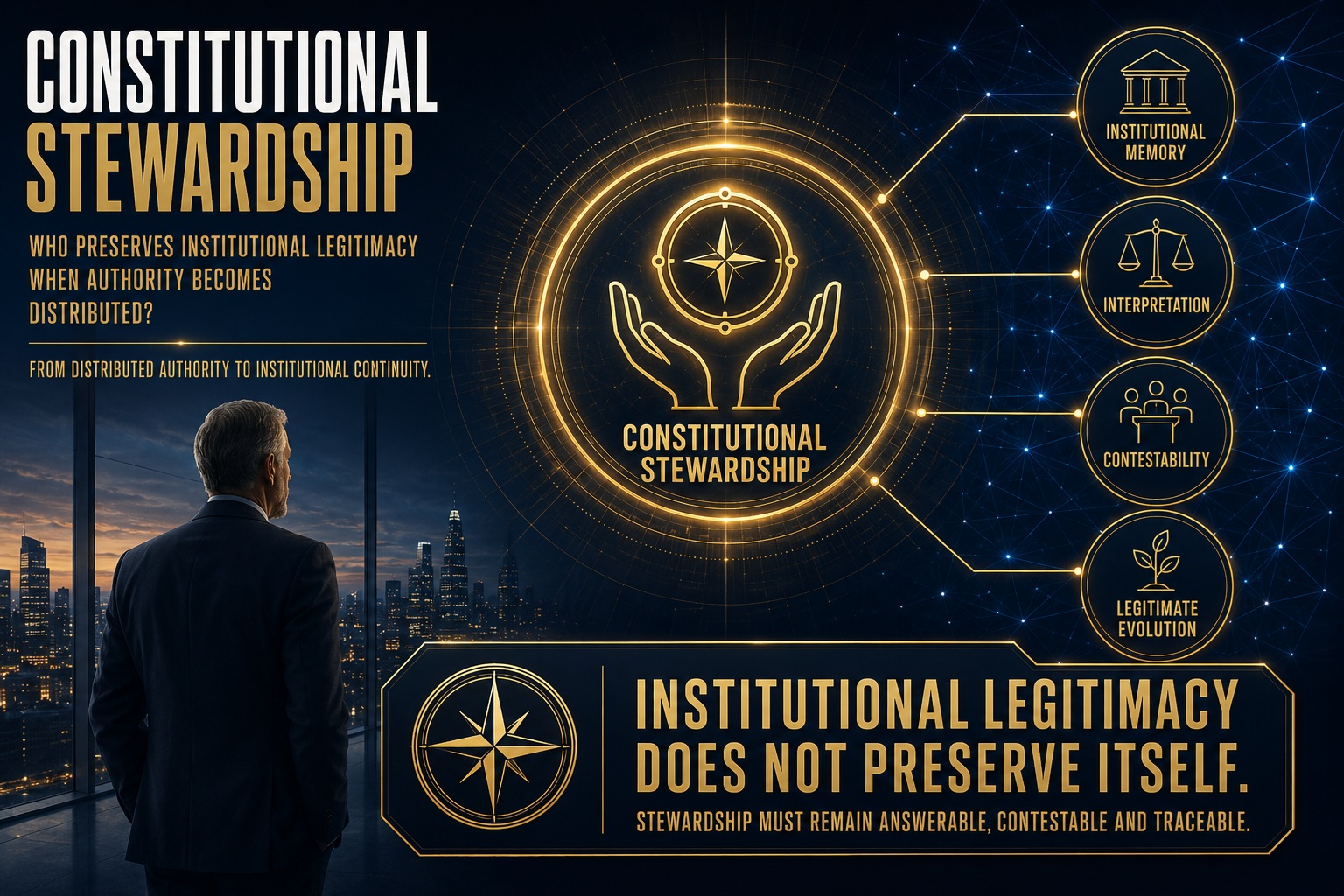 Who Preserves Institutional Legitimacy When Authority Becomes Distributed? Organizations do not preserve their legitimacy automatically. Policies may be documented. Governance structures may be established. Decision authorities may be clearly defined. Constitutional commitments may be formally articulated. None of these, however, is self-executing, self-interpreting or self-renewing. Organizations evolve. Markets change. Technologies mature. Leadership changes. Structures are redesigned. New computational capabilities emerge. Decision formation, recommendation and execution become increasingly distributed across people, teams and computational capabilities. The constitutional challenge therefore extends beyond defining which institutional commitments deserve deliberate preservation. It also requires preserving, interpreting and legitimately evolving those commitments as the organization itself changes. This is the challenge of Constitutional Stewardship. The previous article argued that constitutional organizations intentionally preserve, interpret and legitimately evolve institutional commitments that remain more stable than the ordinary decisions, practices and arrangements they govern. That naturally raises another question. Who preserves those commitments as authority itself becomes increasingly distributed? The answer cannot simply be "everyone." Shared responsibility becomes institutionally weak when it is not accompanied by identifiable authority, differentiated duties and answerability for preservation. Nor should institutional legitimacy depend exclusively on a single constitutional authority acting on behalf of the entire organization. A central body may perform an important stewardship role. But no individual, committee or office should become the exclusive source of constitutional meaning. Constitutional Stewardship therefore begins with a simple observation. Institutional legitimacy requires stewardship. It does not preserve itself. Many organizations possess governance. Fewer consciously develop stewardship. The distinction is fundamental. Governance structures, distributes and constrains authority. Stewardship preserves the institutional legitimacy through which that authority remains recognizable, contestable and worthy of trust. Governance asks: Who may decide, within which boundaries and under what forms of accountability? Stewardship asks: How does the organization preserve, interpret and legitimately evolve the institutional foundations through which that authority continues to deserve recognition? These are different questions. Both are necessary. Neither replaces the other. Governance structures how authority is exercised. Stewardship preserves the institutional conditions through which that exercise of authority remains legitimate across time. Distributed authority can expand organizational capability. Decisions can be made closer to operational reality. Relevant expertise can influence action more directly. Adaptation may become faster and more context-sensitive. Computational capabilities can support analysis, coordination and execution at increasing scale. Yet distribution also introduces an institutional risk. Authority is often easier to distribute than the institutional legitimacy required to sustain its exercise. Responsibility is easier to diffuse than answerability. Interpretation is easier to fragment than coherence is to preserve. Organizations may succeed in distributing decisions while weakening the institutional continuity that allows those decisions to remain collectively legitimate. This is where governance alone becomes insufficient. The organization also requires stewardship. Constitutional Stewardship should not be confused with ownership. Institutional commitments are not the property of any particular organizational actor. They express obligations that extend beyond the tenure, preferences and authority of those temporarily responsible for interpreting them. Stewardship is therefore not ownership or sovereign control. It is an institutionally authorized responsibility for preserving, interpreting and enabling the legitimate evolution of constitutional commitments. The distinction lies not in the absence of authority, but in its purpose. Ownership claims control. Stewardship exercises authority conditionally, on behalf of commitments that no steward may redefine unilaterally. Constitutional Stewardship may be distributed across multiple roles, bodies and relationships. But distribution must not become diffusion. The organization must remain able to identify who is responsible for preserving institutional memory. Who may interpret constitutional commitments. Who can contest those interpretations. Who can require reconsideration. Who may authorize legitimate revision. Authority may be distributed. Stewardship may be shared. Responsibility for preservation must nevertheless remain institutionally traceable. Distributed stewardship therefore requires answerability, countervailing authority and institutional traceability. Answerability ensures that those exercising stewardship can explain and justify how constitutional commitments have been interpreted, protected or revised. Countervailing authority prevents any individual or body from becoming the exclusive source of constitutional meaning. Institutional traceability allows the organization to reconstruct how commitments were interpreted, challenged and revised across time. These conditions prevent distributed stewardship from becoming anonymous, insulated or structurally unaccountable. Constitutional Stewardship also depends on several interdependent institutional capabilities. Institutional memory preserves the reasons, precedents and commitments required to connect past decisions with present interpretation. Institutional interpretation keeps constitutional commitments intelligible and relevant as organizational contexts evolve. Contestability preserves the organization's ability to challenge constitutional interpretations before and after they become embedded in institutional practice. Contestability must, however, be effective rather than merely formal. A constitutional commitment may remain formally open to revision while becoming practically immune to learning if those who surface materially relevant dissent, adverse evidence or alternative interpretations incur personal or professional cost. Constitutional Stewardship must therefore preserve legitimate channels through which such challenges can reach the competent authority, with protection against retaliation, appropriate confidentiality, traceability of how they are handled and an obligation to consider them. Protected dissent is necessary, but it is not self-authorizing. The ability to challenge a commitment does not confer authority to revise it. Revision must remain subject to bounded authority, proportionate deliberation and the legitimacy requirements appropriate to the institutional significance of the commitment. Protected dissent preserves the organization's capacity to recognize when revision may have become legitimate. It does not predetermine whether revision is justified. Coherence examines whether everyday decisions, practices and arrangements remain consistent with constitutional commitments. Legitimate evolution allows constitutional commitments to be revised through processes proportionate to their institutional significance and supported by broader deliberation, justification and authority than ordinary operational change. None of these capabilities exists independently. Together, they allow constitutional evolution without reducing institutional legitimacy to either rigidity or constant revision. Constitutional Stewardship must guard against both excessive rigidity and institutional drift. The less visible of these risks is often drift. Organizations rarely abandon their constitutional commitments through a single deliberate decision. More often, legitimacy weakens through the cumulative effects of successive operational adaptations. Exceptions become precedents. Temporary practices become permanent routines. Optimizations become institutional assumptions. Over time, organizations may discover that they have not consciously revised their constitutional commitments. They may continue to invoke those commitments while no longer preserving the conditions that give them practical meaning. Institutional erosion is rarely dramatic. It is usually incremental. This is precisely why stewardship cannot be understood as occasional constitutional review. It requires sustained institutional attention. Stewardship should not prevent organizational evolution. Its purpose is exactly the opposite. Organizations must remain capable of learning, adapting, innovating and transforming when their purpose and context require it. Constitutional Stewardship preserves the conditions through which that evolution can remain institutionally legitimate. Not every constitutional commitment should remain unchanged. Neither should every commitment evolve with equal ease. Stewardship therefore preserves neither rigidity nor permanent stability. It preserves institutional continuity through legitimately governed evolution. This distinction defines its constitutional role. As organizations increasingly integrate human judgment, computational capabilities and distributed authority, stewardship itself becomes an organizational capability. It is not necessarily a single role, office or governance body. Nor can it depend exclusively on individual leaders. Constitutional Stewardship is not defined by any single organizational form. It becomes organizationally real through identifiable arrangements, practices and relationships that preserve constitutional legitimacy across time. Those arrangements may include differentiated responsibilities, interpretive practices, institutional memory, channels of contestation, countervailing authority and legitimate processes of revision. Their form may vary. Their institutional function cannot disappear. Constitutional commitments cannot remain more stable than ordinary organizational change unless responsibility for their preservation remains identifiable, answerable, contestable and institutionally traceable. Constitutional Stewardship therefore does not determine who governs the organization. It determines how the legitimacy of governance is preserved when authority, interpretation and action become distributed. That legitimacy is not preserved by everyone in general. Nor is it preserved by one authority alone. It is preserved through identifiable stewardship arrangements whose responsibilities remain institutionally visible and whose exercise of authority remains open to justification, contestation and legitimate revision. Yet stewardship cannot depend on intention alone. Those entrusted with preserving constitutional legitimacy must themselves operate within boundaries that prevent interpretation from becoming discretion without limit, preservation from becoming rigidity and authority from becoming capture. This reveals a broader organizational principle. Freedom does not become sustainable through the absence of constraints. It becomes sustainable through constraints that preserve the conditions for legitimate action. That is the question explored in the next article: Constraint as a Strategic Capability: Why Freedom Requires Boundaries. |
Posted on: August 17, 2026 05:35 AM
| Permalink |
Comments (1)
The True Gap in Organizational Transformation
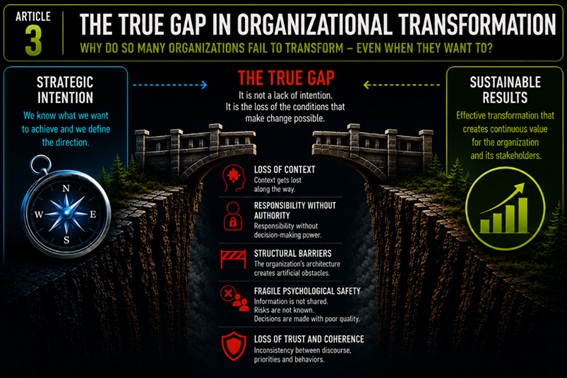 In the previous two articles, I sought to show that Project Management has evolved far beyond the discussion of methodologies. Over the past few decades, the discipline progressively shifted its focus from a concern with methods to an increasing attention toward adaptation, outcomes, products, and context. Subsequently, we saw that this evolution cannot be limited to teams. True adaptive capacity also depends on how the organization distributes authority, structures work, funds priorities, exercises leadership, and preserves strategic coherence. Yet this conclusion inevitably leads to a new question. If today we better understand what characterizes an adaptive organization, why do so many transformation initiatives continue to produce results below expectations? The Closing the Change-Readiness Gap report offers a particularly interesting answer. Its primary contribution does not consist in identifying new methodologies or new organizational models. It consists in showing that many organizations already know, to a large extent, what ought to change. The problem lies elsewhere. It lies in the difficulty of preserving the conditions that allow that intention to be transformed into effective change. It is precisely here that what I consider to be the true gap in organizational transformation resides. The problem is not understanding change For many years, it was relatively common to attribute the failure of organizational transformations to people's resistance. Whenever an initiative encountered difficulties, the explanation emerged almost automatically: People resist change. Although such resistance exists in certain circumstances, this explanation proves insufficient today. Organizations invest increasingly in training, methodologies, technologies, communication, consulting, and transformation programs. Professionals today possess far more knowledge about change management than they did twenty years ago. Despite this, many organizations continue to face similar difficulties. The problem, therefore, appears deeper. It does not result merely from people's capacity to accept change. It results from the organization's own capacity to preserve the conditions that make that change possible. This is a fundamental distinction. When strategy loses meaning The first obstacle identified by the report concerns the progressive loss of context. Organizations invest significant time defining strategy. They clarify objectives. They define priorities. They produce plans. They communicate intentions. However, as those decisions cascade through the organization, part of their meaning is gradually lost. What began as a strategic intention gradually transforms into:
This distinction is decisive. Without understanding context, teams can execute. However, they face far greater difficulty in adapting. Adaptation requires understanding intention—not merely following instructions. When context disappears, part of the capacity to make coherent decisions in the face of unexpected situations also disappears. Strategy then ceases to guide work. It merely describes it. Responsibility without authority remains dependency Another recurring obstacle relates to how decision-making power remains distributed in organizations. In recent years, it has become common to speak of autonomous teams. However, autonomy does not result simply from assigning responsibilities. A team can be responsible for project outcomes and yet remain entirely dependent on successive authorizations to alter priorities, mobilize resources, resolve dependencies, or respond rapidly to new circumstances. In these cases, the organization transfers responsibility. However, it does not transfer effective decision-making capacity. The consequence becomes predictable. Teams remain waiting. Decisions continue to ascend the hierarchy. Priorities shift faster than the organization can respond. Adaptation becomes slow not because teams are incapable, but because the decision architecture remains essentially unchanged. Barriers created by the organization itself The report also calls attention to a particularly relevant phenomenon. Many organizations seek to become more adaptive while simultaneously maintaining structures designed to maximize stability, efficiency, and control. This combination produces permanent tension.
There is a contradiction between objectives and organizational architecture. Organizations begin demanding behaviors that their own structures continue to impede. Psychological safety is also an operational issue The report also addresses a topic that, for a long time, was treated primarily as a cultural issue: Psychological safety. Naturally, an important human dimension remains. However, there is also an organizational dimension that is frequently undervalued. Without psychological safety, information degrades. Risks cease to be communicated in a timely manner. Errors remain hidden. Assumptions cease to be questioned. Bad news ascends more slowly. Decisions come to rely on an incomplete representation of reality. From this perspective, psychological safety ceases to be merely a well-being factor. It becomes an essential condition for the quality of organizational decision-making. The greater the complexity, the greater the importance of this condition. Because adaptive organizations depend on the continuous flow of credible information. Without that flow, adaptive capacity is inevitably reduced. Trust accelerates adaptation There is another element running throughout the entire report: Trust. When trust exists:
Trust, therefore, ceases to be merely a characteristic of interpersonal relationships. It comes to represent an invisible infrastructure of adaptive capacity. The true problem is inconsistency Observing these different obstacles, a common pattern emerges.
The organization seeks to adapt without preserving the conditions necessary for that adaptation to occur.
Not because organizations do not know the path, but because they frequently remain organized according to assumptions incompatible with the outcomes they intend to achieve. The true gap Perhaps this is the main message of the report. The true gap in organizational transformation does not separate strategy and execution. Nor does it separate leadership and teams. Much less technology and people. The true gap separates what the organization intends to achieve from the conditions it preserves to make that intention possible. This distinction profoundly alters how we interpret transformation. Transforming ceases to mean merely altering structures, processes, or methodologies. It comes to mean preserving a set of organizational conditions that make it possible to learn, decide, adapt, and create value continuously. When those conditions do not exist, any transformation initiative will inevitably hit a limit.
Perhaps the greatest contribution of Closing the Change-Readiness Gap is precisely this: To remind us that transforming an organization does not consist merely in defining a new direction. It consists in ensuring that this direction can cascade throughout the entire organization without losing meaning, decision capacity, trust, and coherence. True readiness for change does not depend solely on strategic intention. It depends on the conditions that allow that intention to be transformed into action. And that distinction profoundly alters how we understand Project Management itself. Because projects are, increasingly, one of the primary mechanisms through which organizations materialize their strategy. If these conditions are not preserved, projects will also inevitably encounter limits that no methodology will be able to resolve. The problem, after all, does not consist merely in changing the organization. The true challenge consists in preserving the conditions that allow that change to happen. In the next article, I will analyze the implications of this evolution for the role of the Project Manager and discuss why this professional is assuming an increasingly important role as an integrator between strategy, execution, people, technology, and organizational transformation |
Posted on: August 16, 2026 04:49 AM
| Permalink |
Comments (1)


